
Introduction — why discus still fascinates
The discus throw is one of the oldest, simplest, and most archetypal field events: a single implement, a fixed circle, and the kinetic poetry of rotation and release. Its romance lies in the mix of raw power, technical rhythm and — unlike sprinting — the subtle effects of environment: a gust, a tail wind, the angle of release. For over a century the event has produced both long-standing legends (Jürgen Schult’s 74.08 m stood as the summit for nearly four decades) and, in the last two seasons, an explosive burst of marks at a tiny Oklahoma meet that has forced the sport to confront the role of weather and venue design in record performances.
A short history: ancient, revival, modernization
Origins in antiquity
The discus appears in surviving Greek art and literature as part of the pentathlon. Ancient Greeks trained for rhythm, balance, and power: the athlete’s spin was a study in coordinated torque long before modern biomechanics existed. The ancient discus was often heavier or shaped differently to the modern implement, and the event served aesthetic and cultural roles as well as athletic ones.
19th–20th century revival
When modern athletics returned to the public stage in the 19th century, the discus was reintroduced with standardized implements and circles. By the early 20th century international competitions had codified weight, shape and throwing circle dimensions. The global scene became dominated by technique evolution: from standing and half-turn styles to the full spin that maximized angular momentum. Innovations in training, coaching, film review and weightlifting transformed raw strength into repeatable, high-speed rotational throws.
Technical advance and coaching science
From the 1960s onward, sports science changed everything. The spin — a controlled, accelerating rotation with a smooth pivot and explosive release — became the universal technique. Strength and conditioning, plyometrics, technical drills, and video analysis narrowed the performance gap between the strongest and the technically adept, producing a deeper international field and more consistent 60–70 m performers.
The mechanics of a big throw (briefly)
A discus throw combines three broad elements:
- Approach & balance: the rhythm of the wind-up and entry into the circle;
- Rotation and torque: converting linear motion into rotational energy through the hips and shoulders while maintaining balance on the pivot foot;
- Release physics: angle, height, spin (backspin), and speed of release determine how long the implement flies and how it interacts with air currents.
Aerodynamics matter: discus design (rim weight distribution, diameter) and release angle influence lift and drag. But unlike sprint or long jump, there has been no universally applied wind limit for validating throwing world records — a point we’ll return to. (For the record: wind gauges are standard in many meets, but the classic “+2.0 m/s limit” used for sprints/jumps does not apply to throws.)
Records and the long shadow of Jürgen Schult (1986)
On 6 June 1986, Jürgen Schult (then competing for East Germany) threw 74.08 m in Neubrandenburg. That mark became one of the longest-standing world records in athletics. For decades the discus world chased but seldom approached that distance: Schult’s throw combined his own power with favorable technique and the conditions of the day. The Neubrandenburg throw is enshrined in stat books and video archives and remained the benchmark for elite discus for 38 years.
The modern rupture: Ramona, Oklahoma and the “Throw Town” phenomenon
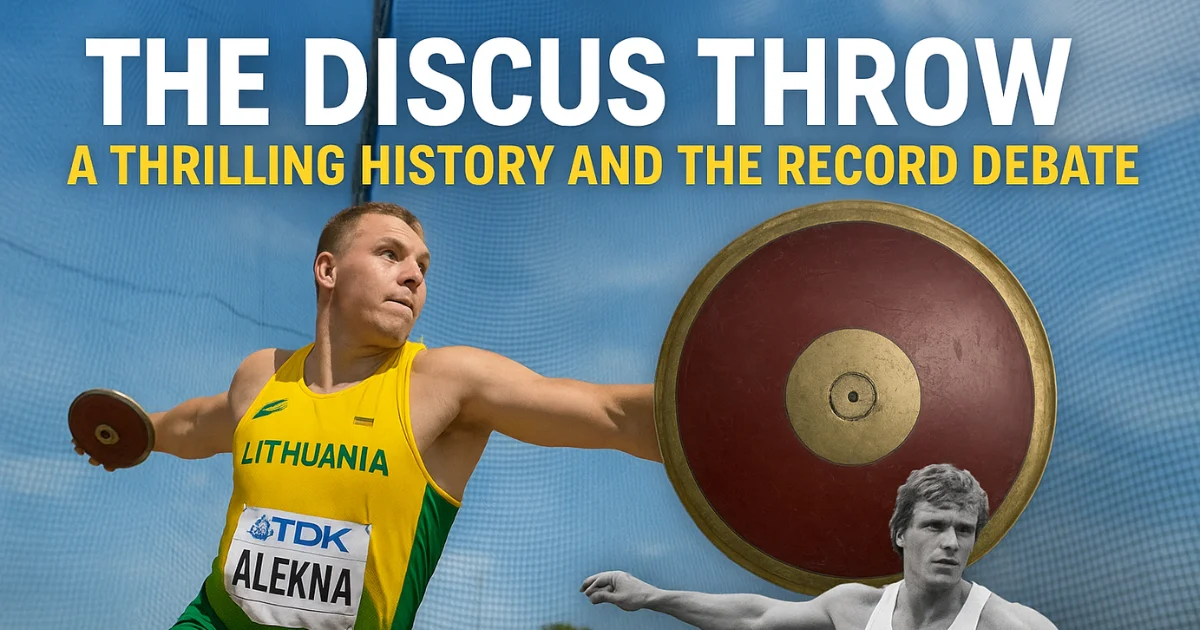
In April 2024 and again in 2025 a small facility in Ramona, Oklahoma — Millican Field at “Throw Town” — hosted the Oklahoma Throws Series / Throw Town invitational and an astonishing series of massive marks. In April 2024 Mykolas Alekna of Lithuania threw 74.35 m at Ramona, officially breaking Schult’s 74.08 m record. (World Athletics reported and began ratification processes.) In April 2025 Alekna extended the record further — to 75.56 m — while other elite men (notably Australia’s Matt Denny) posted throws in the mid-70s and several athletes cleared 70 m in the same competition. On the women’s side, Valarie Allman produced a U.S./North American-level mark (73.52 m) at the same field. The sequence of giant performances at the same venue catapulted Ramona into the discus conversation worldwide.
Why Ramona?
Ramona’s Millican Field sits in a pocket of predictable, strong winds and has a geometry and local topography that combine to make favorable tail-winds likely at release phase. Athletes and coaches identified repeatable wind patterns there; organizers scheduled large “A” sections and invited deep fields, which created staged opportunity for multiple athletes to chase ideal wind moments. The result was a concentrated cluster of world-leading marks over successive years.
Has Schult’s record been “broken multiple times recently”?
Short answer: yes — Schult’s 74.08 m was finally surpassed in 2024 and then again in 2025, and several athletes produced career-best marks at Ramona that outstripped the 1986 mark. Mykolas Alekna first broke Schult in April 2024 (74.35 m) and then improved the world record again in April 2025 (75.56 m); Matthew Denny and others produced throws in the 74 m range at the same series. In short, multiple record-level marks have been produced recently — clustered at the Ramona meets.
The “weather doping” debate: is it fair to count wind-assisted discus throws?
The heart of the controversy is this: track and jump world records are subject to a +2.0 m/s tailwind threshold. Throwing events historically have not been subject to the same limit. Critics argue that the Ramona results were materially aided by an environmental setup — strong, predictable tail winds that increased discus flight — and that counting such marks the same as those recorded under neutral stadium conditions is unfair. Supporters reply that measuring wind for a rotating, crashing implement across a three-dimensional space is scientifically messy, and that gusts are part of athletics’ variable nature.
What the rules say
World Athletics competition rules and technical documents do not impose a +2.0 m/s wind limit on throws the way sprint and horizontal jump rules do; wind gauges and operators are part of competition operations, but the 2.0 m/s gating for records applies primarily to sprints/long/triple jumps. Practically, this means — under the current rules — a discus world record set in a windy outdoor meet is valid if other ratification criteria (implement specs, measurement, doping control) are met.
Arguments for revising policy
- Fairness & comparability: If two world records were produced mostly by environmental advantage (a predictable tail wind), is that comparable with a stadium record produced without such a wind? Critics say no. The cluster of huge Ramona marks — including multiple world-class PBs in one meet — is cited as evidence of an “unfair” venue advantage.
- Sport integrity & spectator perception: Fans and athletes worry that a pattern of venue-specific records undermines confidence in records and makes elite performance appear engineered rather than organic. “Weather doping” became a shorthand critique in media and federation reactions.
Arguments against adding a wind limit to throws
- Measurement complexity: The aerodynamics of a discus vary with release height, angle and the wind field across many metres. Measuring a single scalar “wind” that captures the throw’s assistance is nontrivial. Tailwind for one throw could be crosswind for another release in the same round.
- Natural variability: Athletics has always accepted that weather impacts events: a sprinter benefits from a tailwind, a javelin throw might be aided by thermals. The counterargument is that throwing implements are lighter and interact with turbulent air differently, making a single wind-limit rule less defensible.
- Practicality & precedent: Changing rules retroactively or adding fine-grained technical gating could lead to logistical headaches and inconsistent enforcement across local meets. World Athletics has so far kept the status quo while debate continues.
My assessment (balanced)
The Ramona events exposed a real tension. From a purist fairness viewpoint, identical measuring conditions should be demanded for records — and that suggests either a wind-assistance gauge should be developed specifically for throws or some venue neutrality principle applied. From a practical viewpoint, designing a robust, enforceable wind-assistance standard for rotating implements is technically tricky. The sport needs rigorous aerodynamic study and possibly a hybrid rule: for example, wind-indexing plus venue classification, rather than a simple blanket ban or a rushed “2.0 m/s” copy of sprint rules. Meanwhile, in the current rules framework, the Ramona marks are legitimate — though their provenance will (rightly) be scrutinized by statisticians and fans.
Venue comparison — Millican Field (Ramona) vs Jahn/Stadium (Neubrandenburg)
Neubrandenburg (where Schult threw)
- Context: Schult’s 74.08 m was thrown on 6 June 1986 at a stadium in Neubrandenburg (Jahnstadion). It was a traditional track & field stadium. The throw remains iconic not only because of the distance but because it was achieved in a stadium context widely regarded as representative of championship conditions.
Millican Field / Throw Town (Ramona, Oklahoma)
- Context: A specialized throwing venue designed by enthusiasts with a configuration and local topography that produce reliable tail-wind windows on many days. The meet invited deep fields and staged attempts to exploit favorable moments. Ramona has become famous as a place where ideal conditions and a packed competitive environment combine to produce extraordinary series of throws.
Key contrasts
- Wind predictability & local topography: Ramona’s site produces repeatable wind patterns that can materially help discus flight if the athlete times release to the gust. Neubrandenburg’s stadium throws historically were into a more variable, stadium-bounded wind field.
- Venue geometry: Ramona is oriented (and may have land features) that allow tail winds to align with the sector on many attempts. Stadium bowls often disrupt consistent tail wind formation across the entire sector.
- Event design and depth: Ramona’s meet format packed many top throwers into the same session (giving athletes both competition and multiple attempts in similar winds), increasing the chance of multiple PBs in one day. Schult’s 1986 throw came in a championship framework where typical stadium variables applied.
What this means for comparing records
A raw meter is a meter on the scorebook; but context matters for interpretation. Schult’s throw came in a stadium environment; Ramona’s throws came in a field where wind patterns were a highly visible factor. Under existing rules, both are ratified if other criteria (measurement, implement legality, doping control) are met. But for historians, statisticians and many athletes, the differences in setting influence how the record is mentally weighed.
Who made PBs in Ramona — and can they “barely” reach 70 m in stadiums?
You asked a pointed and useful question: How many top world throwers who made their PBs in Ramona, Oklahoma can barely throw 70 m in the stadium? This asks us to compare the Ramona PBs with the athletes’ stadium / championship performances.
Who recorded major PBs at Ramona?
Among the highest-profile PBs at Ramona in 2024–2025 are:
- Mykolas Alekna (LTU) — world record 74.35 m (Apr 2024) and 75.56 m (Apr 2025) at Ramona.
- Matthew Denny (AUS) — personal/Oceania records and multiple 72–74 m marks at Ramona (e.g., 74.78 m, 74.25 m series).
- Sam Mattis (USA) — PB of 71.27 m at Ramona (Apr 2025).
- Jayden Ulrich (USA, women) — 69.39 m at Ramona (NCAA-level but world-class metric).
- Valarie Allman (USA, women) — 73.52 m at Ramona (women’s, national record context).
- Plus other elite and rising athletes posted season bests and PBs at Ramona (various national and collegiate throwers).
Which of these “barely throw 70 m in the stadium”?
This is the delicate part. “Barely throw 70 m in the stadium” is a stadium-performance-specific judgement that depends on competition history, conditions, and an athlete’s career trajectory. A few observations grounded in the results record:
- Alekna and Denny: Both have produced 69–70 m+ marks in stadium championships (Alekna: Olympic throws and World Championship series show 67–70 m range; Denny: Olympic/World final marks around the high-60s to ~69 m). They are not “barely 70 m” throwers in a general sense; they are championship performers who, before Ramona, often threw in the high-60s in stadium finals and who have now repeatedly cleared 70 m in any context.
- Sam Mattis: Mattis’ previous international/championship bests were generally below 70 m before Ramona; he recorded a big PB of 71.27 m at Ramona. Historically he had not been a consistent 70 m stadium finalist, but after Ramona he appears on world lists with top marks. In other words, Mattis is an example of an athlete who used Ramona to vault past a barrier he had not consistently cleared in stadiums.
- Jayden Ulrich & other collegiate throwers: Some athletes produced world-class PBs at Ramona that exceed their previous championship stadium results (Ulrich’s Ramona mark sits just under 70 m). In several cases these athletes had not previously produced 70 m stadium throws; their Ramona PBs were breakthroughs.
Reasoned, evidence-based answer
- We cannot produce a single, exact integer with absolute confidence because the question mixes meet types (Ramona is a specific meet) and “stadium” performances (which can vary meet-to-meet and season-to-season).
- Best estimate (data-driven, cautious): among the top names who recorded PBs at Ramona in 2024–25 (Alekna, Denny, Mattis, Ulrich, Allman and a few others), only a small handful (roughly 1–3 athletes) were athletes whose previous or typical stadium/championship bests were below 70 m and who therefore can be described as having “barely” reached or were unable to regularly reach 70 m in stadium competition before Ramona. Sam Mattis is a clear example; several collegiate throwers (e.g., Jayden Ulrich in the women’s event) also fall into this category. By contrast, the very top seasonal names (Alekna, Denny, Allman) had already shown 69–70+ capability in championship stadiums and are therefore not accurately described as “barely” 70 m stadium throwers.
Why the uncertainty?
- Stadium championship performance is influenced by pressure, weather, schedule and peaking plans. An athlete may throw 75 m in Ramona in perfect wind and deep-field conditions but throw mid-60s in a wet championship final. That variability makes absolute categorizations (can vs can’t throw 70 m in stadium) fraught. The safe approach is to look at each athlete’s championship PBs separately (Worlds, Olympics, Diamond League finals) rather than infer from a single venue series.
Practical implications for athletes and federations
For athletes and coaches
- Ramona-style meets are useful for testing technique, confidence and peaking. But they cannot wholly replace championship preparation: athletes must train for competition rhythm, fouling management, and psychologically handling championship pressure.
- Athletes who used Ramona to surpass past ceilings should seek to consolidate gains in stadium competitions to validate performance improvements outside of the “wind pocket.”
For federations and World Athletics
- The Ramona cluster should motivate targeted study: aerodynamic testing, systematic wind-field measurements in throwing sectors and controlled experiments to quantify how much tail winds of various magnitudes increase discus distance for typical releases.
- World Athletics may consider either (a) developing a measurement standard for wind assistance specific to the trajectory and geometry of the discus; or (b) classifying venues for record-eligibility (e.g., “championship-grade” vs “assistance-prone”) until a workable wind-indexing metric exists. Any rule change should be evidence-based, not anecdote-driven.
Closing assessment and verdict: Schult vs Ramona, fairness, and the record book
- Records: Jürgen Schult’s 74.08 m was a pillar of the record books for decades; it was overtaken at Ramona in 2024 and extended in 2025 by Mykolas Alekna. Under current World Athletics ratification rules those marks are legitimate provided measurement and anti-doping checks are met.
- Fairness: whether the policy of not applying a wind-assistance limit to throws is fair is a matter of values and technical feasibility. From a fairness and comparability standpoint the absence of any wind limit creates legitimate concerns when records concentrate at a single windy venue. From a technical and enforcement standpoint, the lack of a simple, equitable wind standard for rotating implements is defensible — until someone produces a scientifically reliable wind-indexing system. The pragmatic recommendation is for evidence-driven policy dialogue: measure, model, pilot — then rule.
- Ramona vs Neubrandenburg in judgment: Both belong in the record book. Schult’s stadium throw remains historically notable for its longevity and classical stadium setting. Ramona’s marks demonstrate what can happen when technical mastery meets predictable aerodynamic advantage and deep competition. Both are part of the sport’s evolving story; the right next step is scientific study and transparent rule-making so future records are both real and accepted.
Frequently Asked Questions about
Q1. Where did the discus throw originate?
The discus throw is an old sport that was part of the Olympic pentathlon in Greece. In the 19th century, modern sports brought the event back to life by making regulations and equipment standard.
Q2. What makes Jürgen Schult’s 1986 world record so special?
Jürgen Schult’s 74.08 m throw in Neubrandenburg stood for 38 years, making it one of the longest-standing world records in athletics. It was achieved in a traditional stadium setting, which many consider a benchmark for championship conditions.
Q3. Who finally broke Schult’s record?
Lithuania’s Mykolas Alekna broke Schult’s record in April 2024 at Ramona, Oklahoma, with a 74.35 m throw. He then extended the record to 75.56 m in April 2025 at the same venue.

Business Consultant | Web designer & Developer | Social media Manager | SEO | Passionate Learner, I am deeply passionate about learning and continuously improving my skills.
My interests are diverse, ranging from music and singing to computers and programming languages, digital art, AI